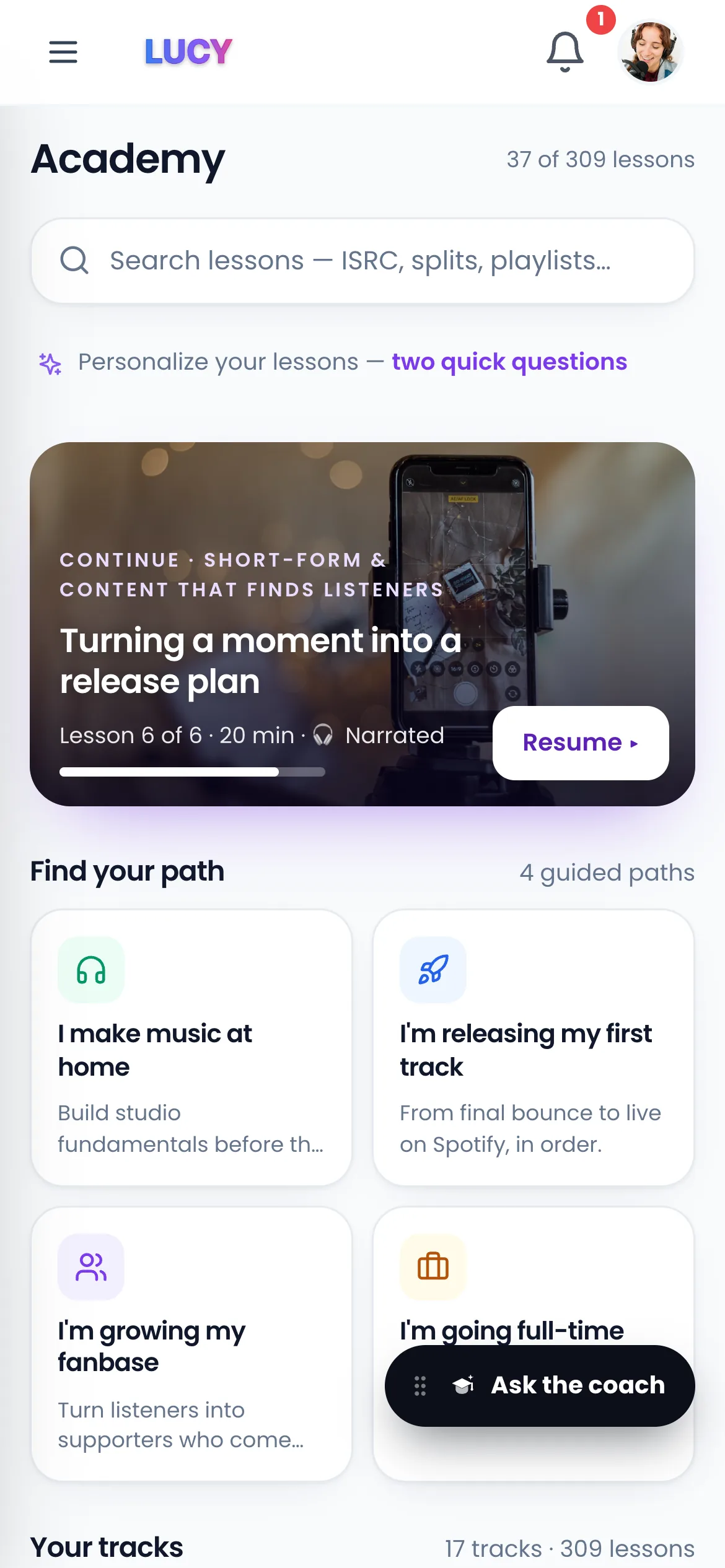
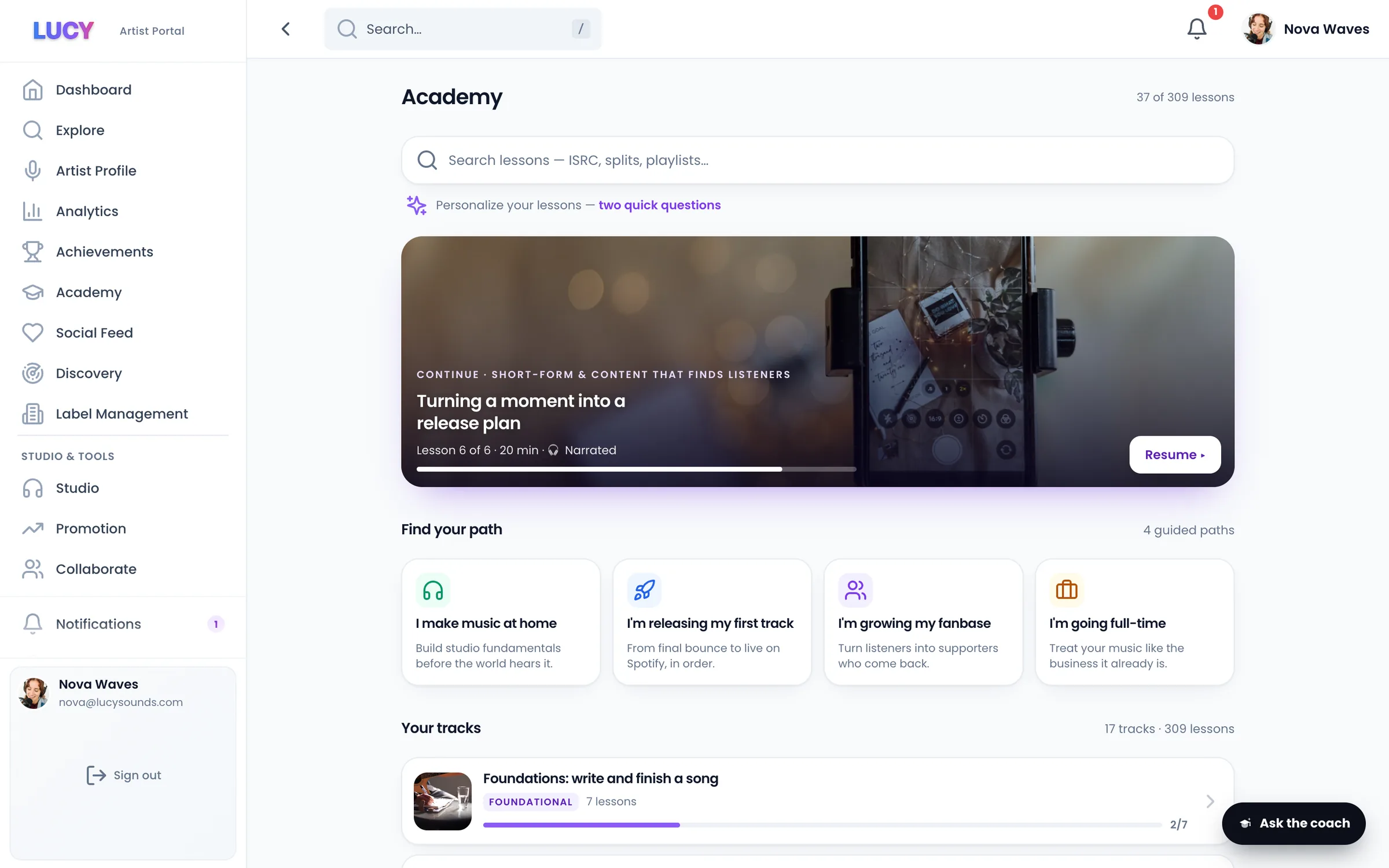
Answer two questions. Every lesson then uses your genre, your stage, and the release you are working on right now.
Examples from your world, not someone else's
Two questions at the start, then every lesson uses your genre and your stage. A bedroom producer hears Bandcamp and Splice. Someone touring hears Songtrust and sync libraries. Same lesson, different room.
Ask about your own release
The coach has read the lesson you're on and can see what's in your account. So “do I need a split sheet for this one?” gets an answer about your track, not a definition.
Listen while you work
Every lesson is narrated. Put one on over a mixdown or the walk home, then a two-minute quiz makes sure it actually stuck.
Never lose your place
Your progress follows your account, not your device. Stop mid-paragraph on the train and it's waiting on the studio desktop.
Start here
Four paths. Pick yours.
Lessons in the order you will need them. No guessing where to start.
LUCY Academy is a free education area on lucysounds.com for independent artists. It explains royalties, rights, and releases clearly, with an AI coach in every lesson and checklists so WAV masters, ISRC codes, metadata, PRO registration, and distributor delivery are not last-minute surprises. Optional AI lessons and Studio Co-Pilot help you apply it to your release.
What is an ISRC and why does my release need one?
An ISRC (International Standard Recording Code) is a unique ID per recording, often described as a digital fingerprint, so streams and sales can be tracked for reporting and royalties. You typically assign one ISRC per track before or during distribution, depending on your workflow.
How do I get my music on Spotify and Apple Music?
You use a music distributor (a delivery service) to send your audio, artwork, and metadata to digital service providers (DSPs) such as Spotify and Apple Music. LUCY Academy lessons walk through metadata consistency, artwork specs, and timing so your release can go live without rejections or delays.
What is a PRO in music publishing?
A PRO (performing rights organization) like ASCAP, BMI, or SESAC collects performance royalties when your compositions are played in public or on many broadcasts and streams. If you write songs, registering with a PRO (where applicable) is part of the revenue side alongside your recording and distribution income.
Does LUCY Academy cost money?
Browsing LUCY Academy is free. Saving progress in the cloud may require a free LUCY account sign-in; there is no separate fee for the education layer described here.
What is the AI coach on lessons?
On supported lessons, Studio Co-Pilot can answer in context after a short five-minute release checklist (WAV master, ISRC, PRO, distributor). You can ask follow-up questions in plain English; the lesson still stands alone if you prefer not to use AI.
Do lessons include videos and curated links?
When live web sourcing is enabled, lessons may include vetted articles, images, or video IDs from search context. Otherwise content stays text-first with optional video blocks when they add clear value.
Why sign in through the LUCY app?
Sign-in ties completions and saved lessons to your secure artist account across devices. You authenticate on the LUCY app and return to lucysounds.com with your session.
What tracks or topics does the catalog cover?
Seventeen tracks. The core path runs songwriting foundations, production and workflow, release and distribution, marketing and audience, and royalties and business. Around it sit rights, splits and publishing; live and touring; sync licensing and placements; direct-to-fan and superfans; short-form content; money, tax and admin; the LUCY app end to end; AI-assisted production; DSP algorithms; spatial audio; sonic identity; and—for builders—LUCY for AI agents and teams. Short lessons you can follow in order or jump straight to what you need.
In the app
Open the Academy. It's free.
Answer two questions and the course reshapes around your music. It is there every time you open the app to release something.
Rewritten around your genre and where you're at
A coach that can see the releases in your account
Narrated — put it on while you work
A badge for the track when you finish it
Open the AcademyFree with your LUCY account · opens the app if you have it
LUCY Academy is a free music business school with over 50 lessons covering distribution, royalties, marketing, and career strategy for independent artists.
Free Lessons for Independent Artists
LUCY Academy is a free music business school designed specifically for independent artists who want to understand the industry and build sustainable careers. With over 50 structured lessons covering distribution, royalties, marketing, metadata, sync licensing, and career strategy, Academy provides the knowledge that labels and managers typically keep behind closed doors.
Every lesson is written in plain language with practical, actionable advice. No corporate jargon, no theoretical fluff. Whether you are preparing your first release or scaling a growing catalog, Academy gives you the tools to make informed decisions about your music career.
AI-Powered Music Business Education
Each Academy lesson includes an optional AI coach that adapts to your experience level. Ask questions, get personalized explanations, and dive deeper into topics that matter most to your specific situation. The AI coach understands music industry context and can help clarify complex concepts like royalty splits, publishing structures, and distribution strategies.
The AI coach is available at no extra cost on every lesson. It supplements the written content by providing on-demand answers and examples tailored to your background, whether you are a bedroom producer, a performing artist, or a music entrepreneur.
What You Will Learn
Distribution Fundamentals: How music distribution works, choosing the right distributor, preparing your release metadata, artwork requirements, and getting your music on Spotify, Apple Music, YouTube Music and 470+ other stores and apps worldwide.
Royalties and Revenue: Understanding mechanical royalties, performance royalties, streaming payouts, PRO registration, publishing rights, and how money flows from listeners to artists in the modern music industry.
Marketing and Promotion: Playlist pitching strategies, social media marketing for musicians, building an audience, email list management, content creation, and leveraging streaming platform algorithms to grow your listener base.
Advanced Topics: Sync licensing opportunities, music metadata optimization, collaboration and feature strategies, catalog management, international distribution considerations, and long-term career planning for independent artists.
How Academy Works
Academy lessons are organized into tracks that progress from beginner to advanced topics. Start with the fundamentals and work through at your own pace, or jump directly to the topics most relevant to your current needs. Each lesson takes approximately ten to fifteen minutes to complete and includes key takeaways you can apply immediately.
Every lesson and every feature of LUCY Academy is free — no fees, no paywalls, no premium tier. You create a free account to track progress and use the AI coach, and that account costs nothing and never will. Our goal is to level the playing field by giving independent musicians the same knowledge that major label artists receive from their teams.
Pick a key and know which chords belong in it. Build a progression on purpose instead of by trial and error. Name what you wrote well enough to register and split it. Know which theory to skip until y
Lay out a song in sections with a reason for each one. Get to the point fast enough that listeners stay. Fix a section that drags without rewriting the song. Understand what skip behaviour tells you a
Write a melody with shape rather than one that wanders. Match stressed syllables to strong beats so lines sound natural. Write specifically instead of reaching for the obvious phrase. Recognise when a
Set up a session you can reopen and understand later. Get from empty project to arranged idea without stalling. Keep files and versions organised from the first session. Know which DAW decisions genui
Capture a vocal that survives mixing without re-recording. Set levels that leave headroom instead of clipping. Improve a bad-sounding room without building anything. Know which faults are fixable late
Decide a track is done on evidence rather than exhaustion. Hand off files a mix engineer can actually work with. Have credits and splits settled before release, not after. Know exactly which lesson to
Hear intervals and chord changes instead of guessing at them. Diagnose a mix problem by name rather than by nudging faders. Build a listening habit that fits around actually making music. Know which r
A single source of truth for identifiers before upload. Artwork that passes common DSP rules on first pass. Credits and spellings aligned across distributor, YouTube, and socials. Fewer “stuck in revi
A backward-planned calendar from go-live. Aligned windows for pitch tools, ads, and content. Clear ownership: who posts, who runs ads, who checks distributor status. A realistic buffer for mastering f
How to read review states and rejection codes. Takedown vs metadata correction: which path to take. Explicit flags, territories, and delivery delays demystified. A repeatable note format for support t
Genre, mood, and language fields used consistently. Explicit and version fields that match the audio. A practical approach to credits vs marketing copy. What you can change after release—and what hurt
Pixel dimensions and color profile that match your distributor. Text and logo rules that avoid common rejections. Thumbnail readability at tiny sizes (carousels and phones)
How official audio, Art Tracks, and uploads interact. Strategies to avoid claiming your own promo or lyric video incorrectly. When to pause uploads until distribution catches up
One primary CTA per campaign in your bio funnel. UTM or built-in analytics so you know what actually drives clicks. Landing copy matched to the post or ad that sent traffic. A refresh routine when a n
Editorial vs algorithmic playlists: different games. Pitch templates that respect gatekeepers’ time. When to follow up (only on material news). How saves, completion, and context fuel algorithmic surf
Prospecting vs retargeting for music campaigns. Budget tiers that match real indie revenue. Creative hooks and when to kill an underperforming ad. A simple measurement stack: what to look at daily
Hook library: openers that fit your brand. Pattern interrupts that don’t feel gimmicky. CTAs that match platform norms (sound-on, text-on-screen). Repurposing one session into a week of posts
Why owned beats rented (platform risk). Opt-in ethics and frequency that don’t annoy fans. A minimal release email structure that gets opens. Tying SMS to high-intent moments only
One-page facts: release date, credits, hooks, comparable artists. Photo kit: horizontal + vertical, credit lines. A bio that leads with story, not adjectives
Gross vs net vs per-stream effective rate. Territory and tier columns that explain swings month to month. Spotting fraud spikes, duplicates, and missing periods. When to open a ticket vs wait for the
Split sheet fields: writers, producers, side artists, royalty % vs publishing %. Work-for-hire vs ownership: know which you signed. When DIY paperwork is enough vs when to call counsel. Sample-heavy a
Writer vs publisher share basics. Registering works without duplicate conflicts. How [[ISWC]] helps across societies (when assigned). Keeping credits aligned with distributor and PRO
A simple model: masters, publishing, live, merch, sync, teaching. How to prioritize one extra income line based on audience. Why diversification beats chasing only playlist adds
Stem exports that mix engineers can actually use. Reference track discipline and revision boundaries. Loudness targets agreed before the final bounce. Written scope: rounds, fees, and turnaround
A single source of truth for sessions and assets. Roles: who approves, who merges, who delivers to distro. Async rituals that work across time zones. Ending projects cleanly: archive, stems, and backu
Choosing references that match energy, not just genre. Headroom habits before mix and master. LUFS targets as a conversation, not a meme. Export formats for mastering
App vs marketing site: https://app.lucysounds.com vs https://lucysounds.com. Sign-in and where profile, catalog, and payouts live in the product. How LUCY Academy opens from the site and from inside t
Draft vs submitted vs delivered states. [[Metadata]] fields that must match across audio, artwork, and credits. How LUCY validates before delivery to stores
Reading delivery and store status (pending, live, issue). Territories, takedowns, and re-delivery without panic. What “propagation time” means in the real world
Analytics (streams, trends, audience signals) vs revenue vs payout: three lenses. Where splits show up and how to reconcile surprises. Statements, cycles, and when to ask support with evidence
Release promotion: one coherent story across feed, posts, and off-platform channels. Shareable links to your profile, tracks, and posts from the app. What to measure before you scale paid spend (and h
Open Academy on lucysounds.com or inside the LUCY app (same lessons, same progress when signed in). Optional in-lesson coach where enabled—still grounded in the module you’re on. When to use in-app he
Community: feed and DMs beside catalog and releases. Collaboration and discovery without spammy behavior. When to use support instead of DMs for money or legal issues
Explore vs your catalog: two different mindsets. Search, filters, and discovery rows that save time. Turning exploration into follows, saves, and real connections
What lives under Services vs day-to-day distribution. Plans, billing, and optional add-ons in one mental model. When to use partner services vs your own network
What Studio is for in LUCY vs your external DAW. How Studio Access and your plan relate (see pricing). Linking Studio work to releases, promotion, and collaboration
When separation is production-ready vs when to replay. Phase, bleed, and artifact checks before you commit. A/B workflow against the original performance
Using suggestions as moves to approve, not gospel. Reference tracks and loudness targets before “AI master”. Protecting dynamics, punch, and vocal intimacy
Saves, completion, repeats, and skips—what to optimize for. How clean [[Metadata]] and delivery through LUCY support discovery. Separating myth from measurable tests
One weekly metrics ritual you will actually keep. What to log when something breaks (IDs, dates, territories). Turning insights into the next release’s hypothesis
What https://app.lucysounds.com/for-ai-agents commits to—and what it does not. Why indie artists, agent frameworks, and labs are addressed on one page. The same Terms, safety, and community bar for ev
Which URLs to fetch so crawlers and copilots stay in sync with production. What agent-welcome JSON vs the A2A-style card vs /.well-known each provides. How to resolve relative paths against your deplo
Web login parity with human artists (Supabase session). Creating scoped keys in Settings → Developer and calling GET /api/agent/v1/me. What “read:profile” means today—and that more scopes are roadmap
How LUCY talks about MCP, webhooks, and A2A—without confusing “planned” with “live”. Why outbound automation still owes users safety and consent. Where to ask partnership questions after sign-in
Tell the composition and the recording apart in your own catalogue. Say who owns each one for every track you have released. Know which income stream belongs to which copyright. Spot the moment a coll
Fill in a split sheet correctly at the session. Handle producers, featured artists and beatmakers without a later dispute. Understand why unequal splits are normal. Know what to do about songs you alr
Choose and join a PRO as a writer. Register your songs so performance income can find you. Know what a publishing administrator adds and what it costs. Understand why unregistered songs generate money
Name the four main publishing income streams. Read which stream a payment came from on a statement. See why one stream can pay while another shows nothing. Identify which streams your catalogue is cur
Know which of the two copyrights each use touches. Clear a sample, or decide not to use it, before release. Release a cover legally without asking permission. Recognise the myths that get releases pul
Find the clauses that decide ownership in any contract. Tell a licence apart from an assignment at a glance. Ask the three questions that change a deal's real value. Know when the answer is to walk aw
Approach a promoter with something they can say yes to. Understand what a promoter is risking and why it shapes the offer. Pick support slots that actually build an audience. Turn one show into a seco
Read an offer and know what you will take home. Tell a guarantee, a door deal and a split apart. Understand what comes off the top before you are paid. Handle settlement without an awkward conversatio
Write a technical rider a venue can actually action. Draw a stage plot and input list that saves soundcheck time. Ask for hospitality without acquiring a reputation. Know what to bring when the venue
Advance a show properly a week out. Confirm the details that most often go wrong. Know who to ask for what at the venue. Arrive without surprises about times, gear or payment
Price merch so it makes money after costs. Know what the venue may take and when to ask. Count stock so you know what actually sold. Choose what to carry for the room you are playing
Build a simple tour budget before confirming dates. Identify the costs that most often get forgotten. Work out what each show has to earn to break even. Decide honestly whether a run is worth doing
Name the two licences a placement requires. Understand what a sync fee does and does not cover. Read the scope of a licence: media, territory, term. Know why the same song can be licensed many times
Explain one-stop clearance to a supervisor in one line. See why deadlines favour independent artists. Identify what in your catalogue is not currently one-stop. Keep future collaborations clearable
Read a brief and judge whether your track fits. Send a pitch a supervisor can act on. Avoid the mistakes that get a pitch deleted. Build a relationship rather than sending one email
Produce the deliverables a placement needs. Organise files so a request can be answered same day. Write metadata that makes a track findable. Audit your existing catalogue for what is missing
Tell a library, an agent and a publisher apart in sync terms. Read an exclusivity clause before signing it. Judge whether a deal is worth the share it takes. Keep pitching your own catalogue alongside
Understand the second income stream a placement creates. Check that a cue sheet was filed correctly. Register the placement with your PRO. Use a placement to get the next one
Tell owned and rented audience apart across your channels. See why follower counts are a weak measure. Pick the one metric worth improving first. Start moving attention to a channel you control
Start a list and collect addresses in the right moments. Write emails that get opened rather than filed. Use the list on release day without burning it. Avoid the mistakes that get you marked as spam
Decide whether a membership fits your practice. Choose tiers and rewards you can sustain. Price it without underselling the work. Keep it running without it eating your creative time
Design merch people want to wear, not just branded stock. Choose between print-on-demand and holding stock. Price for a margin that survives postage. Time drops so they land when attention is high
Compare what a direct sale pays against a stream. Set up a direct sales channel properly. Plan a release day that uses both. Decide what to make exclusive and what to put everywhere
Map the steps between hearing a song and buying a ticket. Design a next step at every stage. Recognise your superfans and treat them accordingly. Build a habit of conversion into normal releases
Know what a voice model can and cannot legally imitate. Understand name and likeness as separate from copyright. Decide what to disclose and where. Avoid the uses that get a release pulled or sued
Judge when an automated master is genuinely fine. Prepare a mix so any master has room to work. Spot the artefacts automated mastering introduces. Know what a human engineer adds that a model does not
Fill in AI declarations accurately at upload. Credit human contributors correctly on AI-assisted work. Understand how disclosure affects distribution. Keep a record of what was generated and how
Name the listener behaviours platforms actually weigh. See why the first 30 seconds decide a track's reach. Read your own numbers for these signals. Improve the signal instead of chasing raw plays
Know what to check on day 1, week 1 and week 4. Tell an editorial bump from an algorithmic one. Recognise when a release is still building. Decide when to spend and when to wait
Diagnose a flat release from the available data. Separate a discovery problem from a song problem. Choose the intervention that matches the diagnosis. Know when to stop working a release
Mix immersive audio for the way most people hear it. Check a spatial mix on real consumer playback. Avoid effects that collapse on binaural rendering. Keep the stereo version the priority it should be
Understand how a spatial mix becomes two channels. Predict which elements survive the fold-down. Test on the devices your audience uses. Deliver both formats with confidence
Weigh the cost of an Atmos mix against the likely return. Identify which of your tracks would benefit. Know what platforms require to accept it. Decide without following the hype
Turn one-off sounds into a reusable personal library. Organise presets so you can find them under pressure. Avoid the sameness trap a preset library creates. Carry your sound between projects and DAWs
Record raw material that only you have. Process found sound into usable instruments. Keep a sound bank organised and rights-clean. Build signature textures nobody can copy
Name the elements that make your sound yours. Change a record without losing the audience. Tell evolution apart from drift. Plan a shift across releases rather than in one jump
Understand what a sound is and why it spreads. Make sure your track exists as a usable sound. Judge short-form success by the right number. Stop measuring your own view count
Pick the section of a track that works as a sound. Cut a clip that loops and invites participation. Leave room for someone else's idea. Test a clip before building a campaign on it
Set a cadence that fits your actual life. Build a small repeatable set of formats. Batch content so it is not a daily decision. Recognise and avoid burnout patterns
Interpret short-form metrics without fooling yourself. Tell reach apart from resonance. Spot which posts drove real listeners. Stop optimising for the wrong number
Find creators whose audience matches your music. Brief a campaign so the posts feel natural. Price and structure a creator deal. Recognise the sellers who deliver nothing
Be ready before a track starts moving. Act quickly when something takes off. Convert a spike into followers and email addresses. Avoid the common ways a moment is wasted
Set up a clean separation between music and personal finances. Understand why mixing them costs you at tax time. Know what a business entity does and does not change. Ask an accountant the right quest
Recognise every stream of music income you receive. Keep records that survive a tax return. Understand the general shape of deductible costs. Know which questions need a local professional
Write an invoice that gets paid. Set payment terms and follow them up. Use a short written agreement for fee work. Chase late payment without damaging the relationship
Understand why foreign income arrives reduced. Complete the forms that lower the deduction. Track what was withheld and where. Avoid being taxed twice on the same money
Identify the risks that actually happen to artists. Know what venues and festivals require. Decide what is worth insuring and what is not. Keep a gear record that makes a claim possible
Build a simple release budget before spending. Decide what a release is actually for. Measure the result against that goal. Learn something usable for the next one
Understand what an advance actually is. Follow how recoupment works against your share. Spot cross-collateralisation before signing. Judge an offer by what you keep, not the headline
Find the numbers that matter on any statement. Reconcile a statement against your own expectations. Understand reporting lag and why periods differ. Raise a discrepancy properly
Get a usable vocal in an untreated room. Fix the problems that make home vocals sound amateur. Choose placement over gear. Know when the room is beating you
Diagnose a mix that is crowded rather than badly mixed. Use arrangement to solve frequency conflicts. Build dynamics across a track. Cut parts without losing the idea
Recognise the difference between unfinished and unfamiliar. Use references and breaks to judge your own work. Set an end condition before you start. Ship instead of polishing forever
Identify which release tasks are safe to automate. Keep a human approval step where it matters. Use scoped keys rather than full access. Log what an automation did and when